


What Is Agentic SOC? The Complete Guide to How It Works and How to Build One
.avif)
An agentic SOC is a security operations center where AI agents take on a growing share of the investigation and engineering work, and people direct that work, check it, and handle what the agents cannot. Agents now work across alert triage and investigation, threat hunting, detection engineering, and remediation and response. Most teams already have some AI in the SOC. In the SANS 2026 SOC Survey, 79 percent of SOCs use AI or ML tools, yet only 36 percent have built them into a defined SOC workflow.
The reason for that gap is how the tools are built, which use cases they address, and how teams put them to work. Most AI in the SOC today works one function at a time. An AI triage tool investigates alerts. Hunts run in a separate tool, or not at all. Detection rules live in the SIEM and get tuned by hand, and response runs through SOAR playbooks. Each tool works from its own data, and its findings stay inside it.
Working in isolation causes two problems. First, what one function learns never reaches the others unless a person carries it over. An investigation that exposes a noisy rule does not tune that rule. Likewise, a hunt that turns up a new technique does not become a detection. Second, the time saved stays in one place. Triage gets faster, but hunts, detection work, and response still wait on the same few people. Those people are already stretched. The average organization leaves roughly 28 percent of its alerts uninvestigated, according to Prophet Security's State of AI in the SOC 2026 report. With the queue unfinished, the hunts and detection work that would shrink it wait too.
On a single platform, the functions share context and feed each other. Investigations show which detections are noisy and which techniques went unseen. Hunts become new detections. Better detections then produce cleaner alerts for the next round of investigations. Agents working across that loop, with people directing them, is what makes a SOC agentic.
So an agentic SOC is something a team builds with intent, one function at a time, fitted to the unique needs of their environment. This guide explains what the model is and how it compares with an AI SOC, SOAR, and MDR. It then walks through each SOC function, how roles shift, how teams mature into the model, and where it is heading.
{{ebook-cta}}
What Is an Agentic SOC?
An agentic SOC is a security operations model in which AI agents take on investigative and engineering work across SOC functions, including alert triage and investigation, threat hunting, detection engineering, and response, sharing context across functions while people set direction, make the judgment calls, approve consequential actions, and review what the agents decide.
The word "agentic" describes how the work gets done. An agent receives a goal, such as "determine whether this alert is malicious," and decides its own next steps. It picks which data to query, reads the results, and changes course when the evidence points somewhere new. A script or playbook, by contrast, runs the same steps in the same order every time.
An agentic SOC still depends on people in several places. Agents can only reason about the telemetry and context they can reach, so a log source nobody connected is a source no agent will check. They also lack the business context behind many decisions, such as which system can go offline during a quarter close. Accountability for consequential actions stays with a person. And agent output has to be measured before it is trusted, which takes people who know what a good investigation looks like. Where those lines fall keeps moving, because agent capabilities change quickly. For now, the people running an agentic SOC own what gets connected, what the agents may do on their own, and which decisions need a human sign-off. Keeping the agents accurate over time is also a human job. It falls to whoever builds the agentic SOC: the vendor, or the team itself for an in-house build. Either way, someone has to measure accuracy continuously and correct the agents when it slips, because environments, threats, and models keep changing.
Agentic SOC vs AI SOC vs SOAR vs MDR
An agentic SOC is an operating model for the whole SOC, while an AI SOC platform is the technology that can power it, and a SOAR platform and an MDR service each cover part of the work. The table below compares them on the points that matter most in practice.
| Dimension | Agentic SOC | AI SOC platform | SOAR | MDR |
|---|---|---|---|---|
| What it is | An operating model for the whole SOC | Software that uses AI agents to do SOC work. First-generation tools triaged alerts only; newer platforms also hunt, engineer detections, and respond | Software that runs pre-written playbooks | A service where an outside team monitors and responds |
| Who investigates | AI agents, reviewed by your team | AI agents, mostly for alert triage | Your analysts, with automated enrichment | The provider's analysts |
| New situations | Agents plan the next step from the evidence | Varies by tool | Needs a new or edited playbook | Provider runbooks and analyst judgment |
| Functions covered | Triage, investigation, hunting, detection engineering, and response, connected | Triage and investigation in first-generation tools; newer platforms add hunting, detection engineering, and response | Enrichment and response workflows | What the contract scopes |
| Your team's role | Sets direction, approves actions, reviews decisions | Reviews agent output; scope depends on how many functions the platform covers | Builds and maintains playbooks | Receives escalations and remediates |
The overlap is real. First-generation AI SOC tools triaged and investigated alerts and stopped there. Newer AI SOC platforms carry agents into hunting, detection engineering, and response, and pass results between those functions, which makes them the core of an agentic SOC. Many teams also keep some playbooks for fixed, repeatable actions. The agentic SOAR debate and the rise of agentic MDR both come from the same shift toward agents making decisions at runtime.
What Makes a SOC Tool Agentic?
Many products now carry the label, so a working test helps. A tool is agentic when it shows four traits during real work, and each one is visible if you watch the tool handle an alert.
- Autonomy. The tool starts work when an alert arrives. It decides which sources to query and which entities to check without an analyst driving each step.
- Planning. The tool builds an investigation plan for the case in front of it. If early evidence suggests account takeover, the plan turns to login history and mailbox rules. If it points to privilege abuse, the plan turns to permission changes instead.
- Reasoning. The tool forms a hypothesis, tests it against the data, and shows which evidence raised or lowered its confidence.
- Adaptability. The tool changes course mid-investigation. A phishing case that turns up a new mailbox forwarding rule should lead the tool to check what data left the account.
A tool that fails these tests may still be useful. However, it is automation, and the people around it will keep doing the judgment work. For a closer look at how these agents operate, see how AI SOC agents work.
How an Agentic SOC Works, Function by Function
An agentic SOC assigns agents to each SOC function and keeps people responsible for the decisions in each one. The split looks different in every function.
Alert triage and investigation
This function carries the most volume. Agents pick up every alert, at every severity, and investigate it the way a senior analyst would. They query the SIEM, EDR, identity provider, cloud logs, and email. They then return a determination of malicious, benign, or inconclusive, with the queries and evidence attached. Related alerts get grouped into one case, so an analyst reads one activity once. Analysts review the determinations, dig into the inconclusive ones, and correct the agents when they are wrong.
Threat hunting
Alerts get worked because someone is already assigned to them. A hunt, on the other hand, only happens if a person with spare time decides to start one. In an agentic SOC, hunts run on their own. Scheduled hunts run on the cadence the team sets. When a severe new threat appears, a hunt for its techniques runs across the environment automatically. When a true positive is confirmed, agents scope the incident by searching for the same indicators and techniques elsewhere. Anything suspicious a hunt finds goes to investigation, so the team receives answers rather than a list of hits to sort through. People decide what is worth hunting in their environment and write custom hunts for the questions only they would think to ask.
Detection engineering
Investigations and hunts produce the raw material for better detections. Agents map coverage against MITRE ATT&CK using what investigations actually saw, including which detections have gone quiet. They flag telemetry gaps, suggest tuning for noisy rules, and draft new detections for techniques that nothing covers. Each proposed change comes with its reasoning and a backtest against the team's own history. Detection engineers review and approve changes before anything reaches production.
Response and Remediation
Agents can take containment and remediation actions, such as suspending an account or isolating a host. Each action type has its own permissions and approval gates, which the team defines. A sensible starting point is to require approval for every action. The team then loosens that one action type at a time, as the record of correct actions grows.
Oversight and tuning
Someone has to keep the agents accurate. People teach the agents about their environment in plain language, such as which accounts are service accounts or which hosts are known scanners. They also review what the agents have learned before it shapes future decisions. Every determination and action leaves an audit trail, so a reviewer can check any conclusion against the underlying queries.
The functions only form an agentic SOC when they feed each other. Investigations produce determinations. Those determinations drive tuning, suppressions, and hunt priorities. Better detections then produce better alerts, and better alerts make the next investigations sharper. A tool that speeds up one function without passing its results to the others leaves the loop open.
SOC Roles in an Agentic SOC
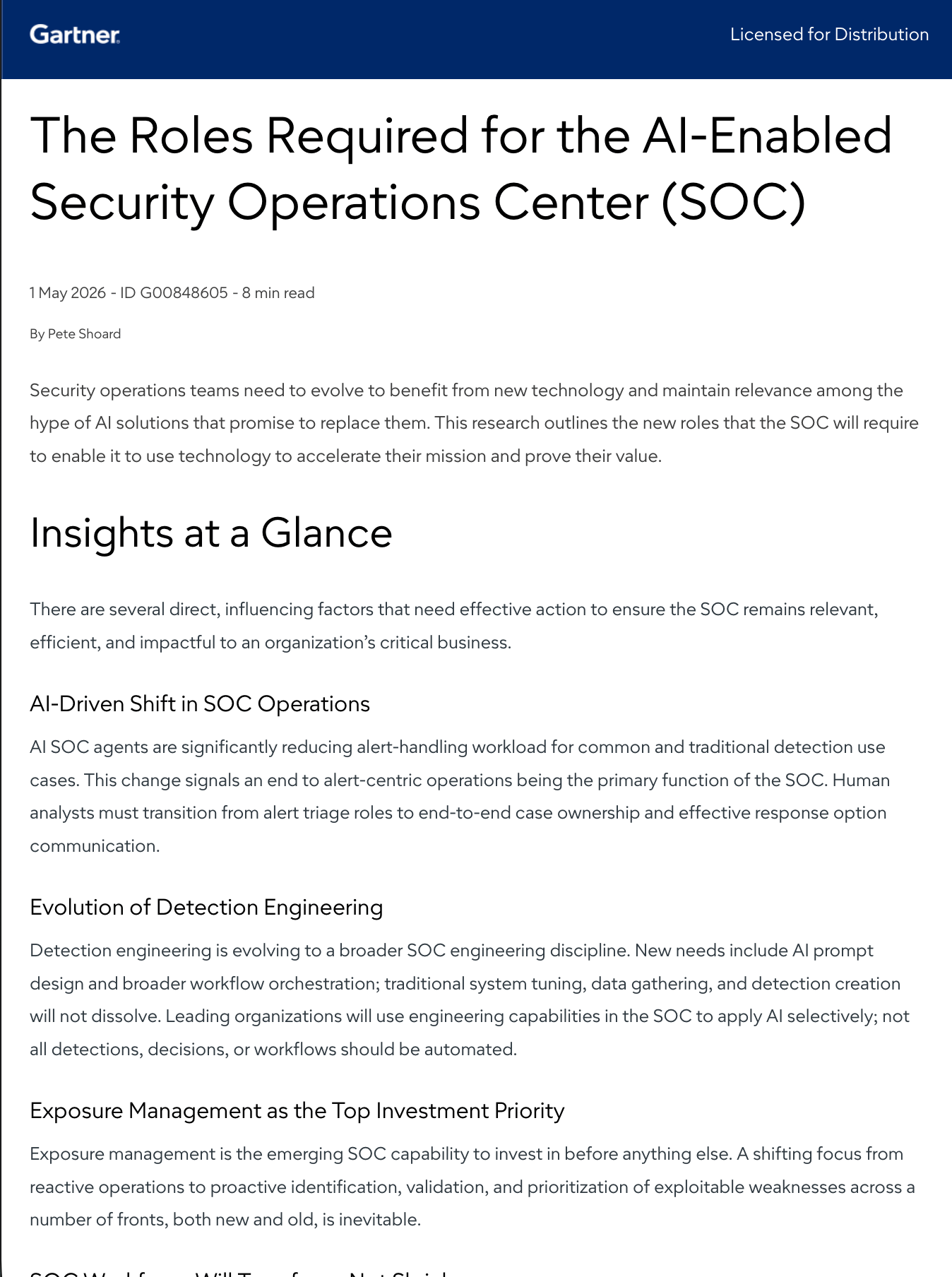
In an agentic SOC, agents take over alert processing. People take over the decisions, the engineering around the agents, and the proactive work that rarely had staff. Gartner says as much in The Roles Required for the AI-Enabled Security Operations Center (SOC): "The SOC will not shrink by 2030. Roles will change radically." Our post on flattening SOC tiers go deeper on the tier-by-tier view.
Tier 1 and Tier 2 analysts become case owners
Analysts stop working alerts row by row. Instead, each analyst owns cases from start to finish. They validate the agents' determinations, decide on response, explain the case to stakeholders, and send corrections back so the agents improve. The old split between Tier 1 and Tier 2 fades, because the agents handle the first pass that used to define Tier 1. Gartner expects the L1 triage analyst to "evolve completely into a 'case validator' role" by 2030.
Detection engineers take on the engineering around the agents
Detection engineering grows as a discipline. Engineers still write and tune rules. They also decide where AI belongs and where fixed logic must stay, test agent output, and run detections as code with versioning, backtesting, and rollback. Gartner expects the engineering side of the SOC to keep growing: "By 2028 there will be 50% more engineers in security operations teams than analysts."
Threat hunters focus on what to look for
Hunters spend less time running queries and more time deciding what to look for. They judge which threat intelligence matters to their environment, design hypotheses, and turn good findings into lasting detections.
SOC managers run the SOC on cases and decisions
Managers stop measuring the SOC by alert volume and closure rates. Instead, they track case accuracy, investigation time, and how confident the team is in each decision. Gartner gives the same advice: "Stop recording alert metrics and run the SOC on cases and decisions." They also govern the agents the way they would govern any operator with system access, with change control, audit trails, and approval paths.
As reactive work shrinks, some teams add offensive and exposure-testing skills, a shift covered in the last section. Throughout, the limits described earlier keep people in the loop. Agents act only on the data they can reach, and consequential actions need human approval until a track record earns more autonomy.
How to Build an Agentic SOC: A Maturity Path
Teams build an agentic SOC in stages, and each stage depends on the one before it. The path below describes what each stage gives the SOC and the signal that a team is ready for the next one.
Stage 1: AI triage and investigation
Agents investigate every alert and group related alerts into cases. Analysts come to trust the determinations in three steps.
- Observation mode. Agents investigate every alert, but their determination is one more input for the analyst, who still makes the call. Comparing the two on the same alerts gives the team a measured accuracy rate.
- Agents close benign alerts. Once accuracy stays high over weeks of real alerts, agents close the alerts they find benign, and analysts take the malicious and inconclusive ones. This step depends on continuous measurement, such as regular sampled reviews of closed alerts, with a flag to the team when accuracy drops below a set threshold.
- Feedback and more data. Analysts correct wrong determinations and teach the agents about the environment, while the team connects more data sources. Each correction and each new source makes the determinations more accurate and more useful.
- Ready for the next stage when accuracy holds above the threshold beyond the pilot, and analysts act on determinations without redoing the investigation.
Stage 2: Threat hunting
Hunting goes from occasional to continuous in four steps.
- Vendor-provided hunts. The team runs ready-made hunts the vendor supplies for common attacker techniques. They need little setup and show what regular hunting turns up in the environment.
- Hypothesis-driven hunts. The team writes its own hunts around questions specific to its environment, such as unusual access to a critical system. Agents then run them on a schedule the team sets.
- Autonomous emerging-threat hunts. When a new threat appears, agents check whether it applies to the environment, based on the systems and software involved, and hunt for its techniques without waiting for a person. When an investigation confirms a threat, agents also scope it by searching for the same indicators and techniques elsewhere.
- Hunts turned into detections. When a hunt finds real activity, the team converts it into a permanent detection. The next time that behavior shows up, it raises an alert instead of waiting for the next hunt.
- Ready for the next stage when every hunt finding lands in investigation instead of a backlog, and successful hunts regularly become detections.
Stage 3: Detection engineering
Agents take on the groundwork, and engineers move to reviewing and approving what the agents propose. That shift happens in four steps.
- Coverage mapping. Agents map detection coverage against MITRE ATT&CK using what investigations actually saw. They flag detections that have gone quiet and log sources the SOC is missing.
- Tuning. Agents propose fixes for noisy rules based on how investigations of their alerts turned out. Each change comes with its reasoning and a backtest against the team's own history, and an engineer approves it before it ships.
- New detections. Agents draft detections for techniques nothing covers, including those that hunts surface. Agents then backtest each one against the team's own history, showing what it would have caught and how often it would have fired. Engineers review them like code, with versioning and a way to roll back.
- A closed loop. Investigations, hunts, and detections now feed each other without a person carrying findings from one to the next.
- Ready for the next stage when proposed changes routinely pass review, few need to be rolled back, and the known coverage gaps keep shrinking.
Stage 4: Human-gated response
Agents take containment and remediation actions, each behind permissions and approval gates the team defines. Trust in those actions builds in three steps.
- Recommended actions. Each case comes with a recommended response, such as resetting credentials or isolating a host, and a person carries it out. The team checks how often the recommendation was right.
- Approved actions. Agents carry out actions once a person approves them. Each action type has its own permissions and approval gate, which the team defines.
- A record by action type. The team tracks, for each action type, how often the agents proposed the right action and whether any action disrupted the business.
- Ready for the next stage once an action type has a long record of correct, approved actions.
Stage 5: Autonomous response, by action type
Defined action types run without approval, and autonomy widens only as the record supports it. It starts small and widens in three steps.
- Low-risk actions first. The first actions to run without approval are low in impact and easy to undo, such as quarantining a phishing email or ending a user's active sessions.
- Guardrails. Autonomous actions run within limits the team sets, such as excluding executive accounts or production servers. Every action is logged with the evidence behind it.
- Wider autonomy as the record grows. More action types run on their own as their records support it. Any action type that misfires goes back behind approval.
- Ready for the next stage when this daily work runs reliably enough to free up time for testing ahead of attackers.
Stage 6: Continuous adversary emulation
The SOC starts testing itself the way an attacker would, in three steps.
- Adversary emulation. Agents replay a named threat actor's tradecraft against the environment and record what the SOC caught.
- Detection validation. Agents confirm that existing detections fire on the behavior they were written for.
- Closing the gaps. Each miss turns into a new detection, which goes through the same review as any other change. Runs repeat on a schedule and after major changes, so coverage is tested rather than assumed.
Governed learning and expert review apply at every stage. For the questions to ask vendors at each stage, see our evaluation guide.
How to Tell Whether an Agentic SOC Is Working
Alert counts and closure rates say little once agents handle the volume. The more useful measures describe cases and decisions.
- Case accuracy. How often the determination on a case holds up under review.
- Investigation time. How long a case takes from first alert to a decision the team stands behind.
- Decision confidence. How often the team acts on a determination without redoing the investigation.
- Coverage. The share of alerts that receive a full investigation, and the change in detection coverage over time.
- Time shifted. How much analyst time moves from triage to hunting, engineering, and case ownership.
Our guide to SOC metrics covers how to measure the traditional numbers well while this shift happens.
Where the Agentic SOC Goes Next
Every stage so far reacts to something that already happened, such as an alert, a disclosure, or a confirmed incident. The next stage tests the environment the way an attacker would, before an attacker does. It builds in three layers.
The first layer is adversary emulation, often sold as breach and attack simulation. Agents replay a specific threat actor's tradecraft against your environment and record what the SOC caught. Each run can end with new detections for whatever was missed.
The second layer is detection validation. Agents confirm that existing detections actually fire on the behavior they were written for. That tells the team what its coverage map is really worth, since a detection that never fires offers the same protection as no detection.
The third layer is continuous threat exposure management. Here, finding and validating exposures becomes a standing SOC function rather than an annual test. In Gartner's words, "By 2030, the primary output of the SOC will not be 'alerts reviewed,' but validated cases with clear business impact, recommended actions, and documented rationale."
Final Thoughts
The risk in a partly agentic SOC is that it looks finished. Triage runs fast, the dashboards improve, and meanwhile detections go untuned and hunts never run, because those functions still depend on people who have no time. An agentic SOC closes that gap only when agents contribute to every function and the results flow between them.
Nothing in this description is unique to one vendor, and the same tests apply to Prophet Security. Prophet AI investigates every alert with the queries and evidence attached. It runs scheduled and emerging-threat hunts and sends findings straight to investigation. It also turns investigations, hunts, and coverage gaps into backtested detections your team reviews before they ship. To see how that works in your environment, request a demo.
Insights
The Roles Your AI-Enabled SOC Will Need
Gartner research on how SOC roles shift as AI SOC agents reduce alert-handling work

As the Director of Product Marketing at Prophet Security, Ajmal drives marketing and growth strategies and helps security professionals see how AI is transforming security operations.